Albania eSIM guide: roaming in the Western Balkans, border areas and road trips
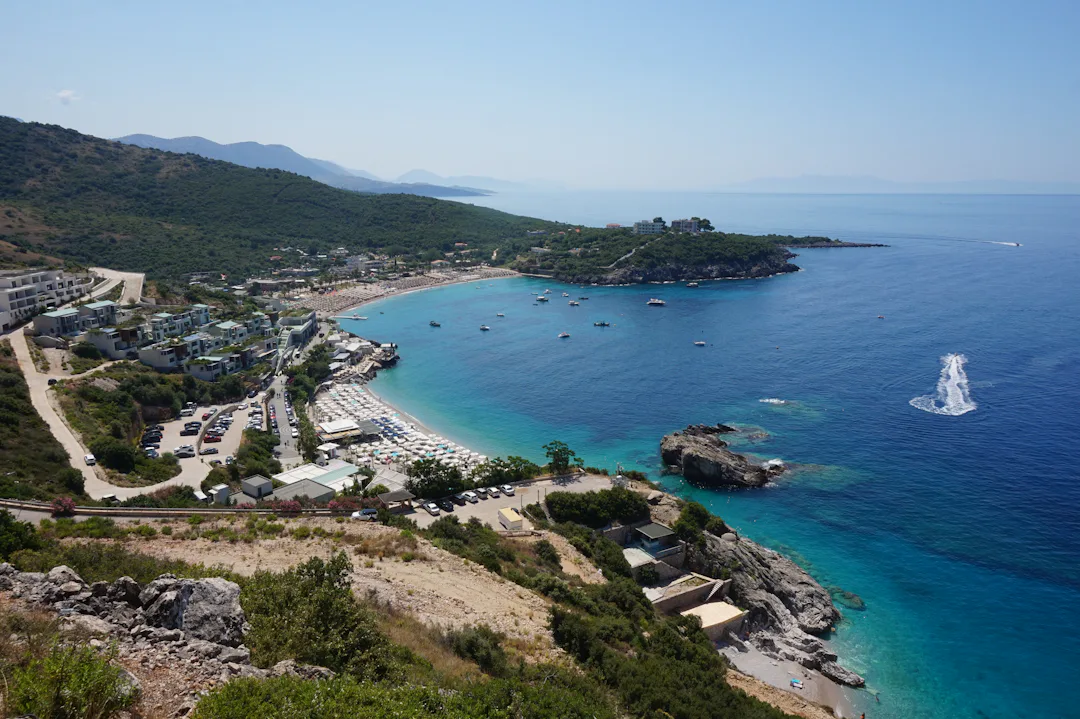
A week on the Albanian Riviera, a drive from Kotor to Mostar and on to Lake Ohrid, a hike through the Albanian Alps: the Western Balkans are one of Europe’s fastest-growing holiday regions, and almost every trip there crosses a border or two. What catches people out is that none of the six countries on this page is in the EU. An Albania eSIM, or a plan that covers your whole route, gives you mobile data at a final price you know before you set off.
This guide covers Albania and its non-EU neighbours: Montenegro, Kosovo, North Macedonia, Bosnia and Herzegovina, and Serbia. It explains what roaming on your own plan does and doesn’t cover, where the EU’s roaming talks with the region stand, which border areas switch your phone onto the wrong network, and what coverage is like on the coast and in the mountains. You’ll find the eSIM plans for Albania in the Visomu app.
Roaming in Albania and the Balkans: what applies in November 2026
The EU’s “roam like at home” rules apply only inside the EU and the EEA. Albania, Montenegro, Kosovo, North Macedonia, Bosnia and Herzegovina and Serbia are candidates or potential candidates for membership, but none of them is a member, so the rules don’t reach them. With a plan from an EU country, what you pay depends on your operator: some include one or more of these countries in a bundle or a travel add-on, others charge them as countries outside the EU. Look up each country on your route separately on your operator’s roaming page, because the answer can differ from one country to the next.
The EU–Western Balkans roaming deal: where it stands
Two things are happening, and neither yet makes roaming free for visitors from the EU:
- A voluntary operator agreement. Since 1 October 2023, 38 operators from the EU and the Western Balkans have been lowering their data roaming prices between the two regions step by step, with the aim of bringing them close to domestic prices by 2028. It covers only the operators that signed it, and only data.
- Talks on joining “roam like at home”. The European Commission proposed in February 2026 to negotiate with all six partners; the Council of the EU authorised the talks in June 2026, and the Commission announced on 6 November 2026 that bilateral negotiations had started with each of them. Each country must first conclude its agreement and fully align with EU roaming rules. No date has been set.
So for a trip this winter or next summer, plan as if these countries are outside EU roaming, and check whether your own operator has already cut its prices.
Free roaming between the six, but not for visitors
Since 1 July 2021 the six have formed a roaming-free area of their own: a SIM from Serbia or Albania can be used in the other five at home prices, within a fair-use limit. That helps residents, not visitors. If your phone runs on a plan from home, crossing from Albania into Montenegro is simply roaming in another non-EU country.
If you’re travelling from the UK, the US or Latin America, all six count as international roaming with your own operator, and usually as separate countries.
Choosing an Albania eSIM for one country or a whole route
- Albania only: a beach week in Ksamil or Himarë, or a city break in Tirana. An Albania plan is the simple choice.
- A route through several countries: check that every country you’ll sleep in or drive through is in the plan’s list of countries. The neighbours have their own pages: Montenegro, Kosovo, North Macedonia, Bosnia and Herzegovina and Serbia.
- The Balkans as part of a longer Europe trip: a Europe plan covers many countries, but not every option includes these six. Check the countries listed in the app before you buy, and see our Europe eSIM guide.
A plan’s validity starts when the eSIM first connects in a country it covers. If the plan also covers the country where you install it, as a Europe plan installed at home in the EU may, it can start straight away, so switch the line off until you travel. Where the plan allows, you can add data in the app, which tells you before you buy whether a plan can be topped up. For some destinations there are day passes for exactly the number of days you choose.
Border areas where your phone picks the wrong network
Coastal borders run close to towns and beaches here, and phones connect to the strongest signal, not to the country you’re standing in. Four places to know:
- Dubrovnik and the Bay of Kotor. Around Cavtat and the Konavle valley in Croatia, an EU SIM can latch onto a Montenegrin network and roam outside the EU without you noticing. Going the other way, around Herceg Novi a Montenegro-only plan can find a Croatian network that it doesn’t cover.
- Neum. The coast road between Split and Dubrovnik used to cross a short stretch of Bosnia and Herzegovina at Neum. The Pelješac Bridge, open since 2022, lets the main route bypass it, but if you stop in Neum you’re in a non-EU country.
- Corfu and Saranda. The ferry from Corfu takes you across a narrow strait. Around Saranda and Ksamil your phone may still see a Greek network, and on Corfu’s north-east coast an EU SIM can slip onto an Albanian one.
- Lake Ohrid and Lake Prespa. Both lakes are shared by Albania and North Macedonia. On the shore near Pogradec or Struga, the other country’s network is often within reach.
Two habits prevent surprises: turn off data roaming on your home SIM before you reach a border area, and if your eSIM loses data near a border, choose a network of the country you’re in by hand in your phone’s mobile network settings.
Coverage on the coast, in the cities and in the mountains
Albania has two mobile network operators, One and Vodafone; Montenegro, Serbia and Bosnia and Herzegovina each have three, and North Macedonia and Kosovo have their own national operators. In the capitals, the larger towns and along the main coast you can generally expect 4G, and 5G is being rolled out in several of the six.
The picture changes once you leave the main roads. In the Albanian Alps, on the mountain road to Theth and in the Valbona valley, signal comes and goes, and on the trails between villages it may be absent for hours. The same goes for Durmitor and the Tara canyon in Montenegro and for the mountains along the Kosovo border. The Peaks of the Balkans trail crosses the borders of Albania, Montenegro and Kosovo away from official checkpoints, which needs permits from each country’s police, and on the ridges your phone may connect to a different country than the one you’re walking in. Download offline maps and your route before you go, tell someone where you’re heading, and don’t count on a signal to call for help.
Wi-Fi, apps and how much data a road trip uses
Most hotels, guesthouses and beach bars offer Wi-Fi, but quality varies, and on the road, at border crossings and on the beach you’ll be using mobile data. That’s also when you need it most: navigating mountain roads, checking ferry and bus times that change with the season, and messaging hosts. Many guesthouses and small hotels take questions and arrival times through WhatsApp, and Viber is widely used across the region.
On a road trip, data use is mostly navigation, messaging and photos, which stays modest. What uses a lot is streaming, video calls and sharing your connection with a laptop or the children’s tablets in the back seat. Start with a plan that fits your habits, check the usage counter in the app after the first days, and let the app warn you when data runs low.
Setting up before you drive or fly
First check that your phone supports eSIM and isn’t locked to your operator. Then:
- Install the eSIM at home on Wi-Fi, a few days before you leave and before its install deadline: the app shows a countdown and sends reminders. Our guides for iPhone and Android walk you through it.
- Label the line, for example “Balkans”, and keep your home SIM as the line for calls and texts, so bank codes still reach you.
- Turn off data roaming on your home SIM before you cross into the first non-EU country.
- On arrival, switch mobile data to the eSIM, and turn on data roaming for the eSIM line if the app’s instructions say so.
The eSIM is for data only and has no local phone number. WhatsApp and other calling apps keep working over its data; see how to keep WhatsApp and your own number. If something doesn’t work, use “Mail us” in the app and we’ll reply by e-mail.
Before you travel to Albania and the Balkans
- Check each country on your route on your operator’s roaming page.
- Choose a plan that lists every country you’ll pass through, Kosovo included.
- Install the eSIM at home on Wi-Fi and turn off data roaming on your home SIM.
- Watch your network near Dubrovnik, Neum, Corfu and the lakes.
- Download offline maps before heading into the mountains, and pack a power bank.
Frequently asked
Is roaming free in Albania for travellers from the EU?
No. Albania is not in the EU or the EEA, so roam like at home doesn't apply. Some EU operators include Albania in a bundle or have lowered their prices under a voluntary agreement since October 2023, others charge it as a country outside the EU. Check your own operator's roaming page.
When will EU roaming rules cover the Western Balkans?
There is no date yet. The Council of the EU authorised talks in June 2026 and the Commission announced in November 2026 that negotiations with each of the six had started. Each country must conclude its agreement and fully align with EU roaming rules first. Separately, operators that signed a voluntary agreement aim to bring data roaming prices close to domestic levels by 2028.
Does an Albania plan also work in Montenegro or Kosovo?
Only if those countries are in the plan's list of countries. A plan for a single country covers that country. For a route through several countries, choose a plan that lists all of them, and check the list in the app before you buy.
Will I have signal in Theth and the Valbona valley?
In the villages often, but not everywhere. On the mountain road and on the trails between valleys, coverage is patchy and can be absent for long stretches. Download offline maps and your route before you go.
Why did my phone connect to a Montenegrin network in Croatia?
Near the border, around Cavtat and the Konavle valley, your phone may pick the strongest signal, which can come from Montenegro. With an EU SIM that means roaming outside the EU. Turn off data roaming on your home SIM and choose a Croatian network by hand if needed.