Maldives eSIM guide: data on resort islands, local islands, boats and liveaboards
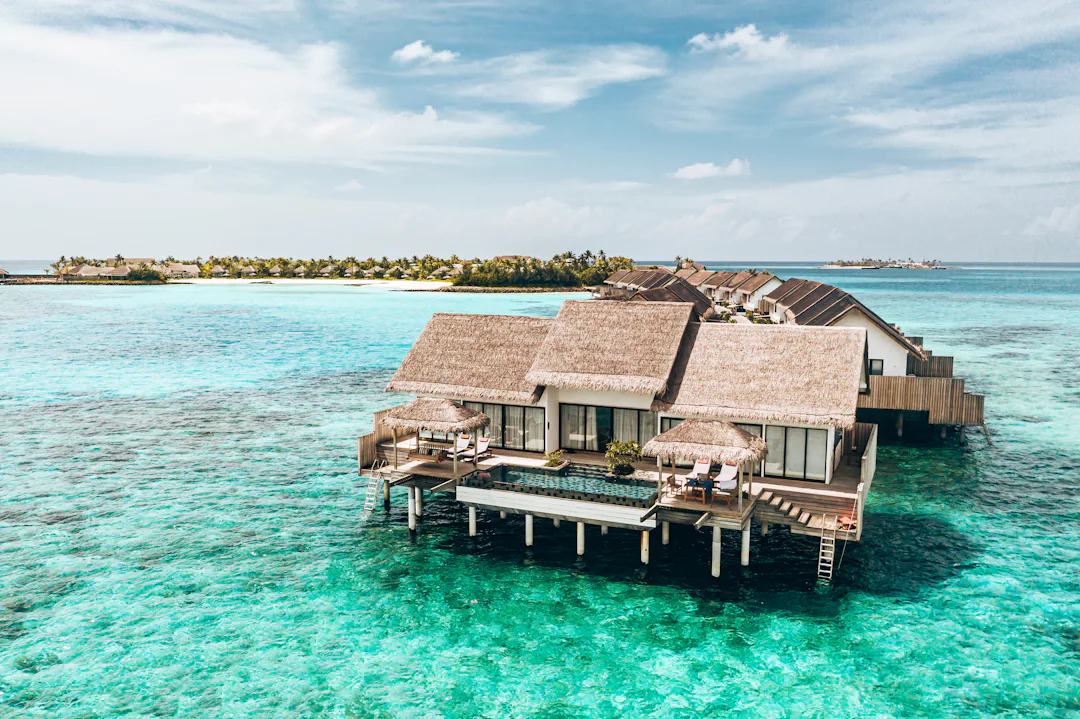
The Maldives looks like the place to switch off, and for many people it is. But you still need to find your transfer at the airport, message the resort about a delayed flight, share the view with home and back up a week of photos you can’t take again. A Maldives eSIM gives you your own mobile data from the moment you land, so you’re not tied to the resort’s Wi-Fi or a roaming bill from home.
This guide covers what is specific to the Maldives: arriving at Velana, getting online between islands, resort islands versus local islands, diving days and liveaboards, and how much data a trip like this really uses. You’ll find the eSIM plans for the Maldives in the Visomu app.
Landing at Velana: why data matters in the first hour
Almost every international flight lands at Velana International Airport, on Hulhulé island next to Malé. Its new passenger terminal opened in July 2025, with seaplane check-in counters inside. A resort representative usually meets you there and takes you to a speedboat, seaplane or domestic flight.
That handover is where your own data helps. Resorts and transfer desks often send updates by message, the seaplane operator only flies from sunrise to sunset, and Trans Maldivian Airways advises arriving by 15:30 if you want to reach your resort the same day. Flight times are not always set far ahead, so you may wait in a lounge for your seaplane. If your connection is late, you want to tell someone quickly.
One task comes before you even board: the Maldives asks every traveller to submit an online traveller declaration, IMUGA, before the flight. It is free on the official immigration portal; check the timing there.
Mobile networks in the Maldives
There are two mobile operators: Dhiraagu and Ooredoo Maldives, overseen by the Communications Authority of Maldives (CAM). Both have built 5G out quickly. As of 2026, Ooredoo reports 5G reaching about 80% of the population and Dhiraagu about 73%, while Dhiraagu says its 4G covers inhabited islands, resort islands and the main industrial islands. In practice, Malé, Hulhumalé and the larger islands have the fastest connections; elsewhere, expect 4G.
Population coverage is not the same as coverage everywhere, though. The country is around 1,200 islands spread over 26 natural atolls, and a mast on an island only reaches so far over water. A travel eSIM connects through a local network; which one depends on the plan.
Resort islands and local islands: two different trips
On a resort island
Almost every resort offers Wi-Fi, but quality varies a lot. The connection is shared by every guest, and it is often weakest exactly when everyone goes online, after sunset. Over-water villas at the end of a long jetty, a beach villa at the far side of the island, the spa or a sandbank picnic can all sit at the edge of the network. Your own data covers those gaps, and it means a video call home doesn’t depend on the Wi-Fi in the restaurant.
On a local island
Since guesthouses were allowed on inhabited islands, places such as Maafushi, Thulusdhoo and Dhigurah have become a popular way to see the Maldives. These are real communities with mobile masts, so data usually works well in the village. Guesthouse Wi-Fi is often one small connection for every room. Day trips to sandbanks, snorkel spots and other islands also rely on mobile data. Note that the rules on local islands differ from resorts: alcohol is only available on resort islands, and government travel advice asks for modest dress outside designated bikini beaches.
Between islands: speedboats, seaplanes and open water
Transfers are part of the experience, and your connection changes with them:
- Speedboats within North and South Malé Atoll usually stay close enough to islands for a signal, with gaps in the wider channels.
- Seaplanes are short flights at low altitude; follow the crew’s instructions about phones and enjoy the view.
- Domestic flights to the southern atolls are followed by a boat transfer, so let the resort know when you land.
- Excursions to sandbanks, dolphin trips and whale shark tours can take you out of range for a while.
Save the resort’s phone number and booking details offline before you set off. If a transfer runs late, you then still have the information without a signal.
Diving days and liveaboards
Many visitors come for the diving, and a liveaboard (a dive safari boat) changes the picture most. Some operators run their on-board Wi-Fi over the local mobile network: it works well near islands and becomes unreliable on overnight crossings between atolls. Your own eSIM behaves the same way, so plan on hours without a connection.
- Download your dive logs, offline maps and anything you want to read before a crossing.
- Tell family when you expect to be offline, so silence doesn’t worry anyone.
- Ask the operator how they call for help at sea. The UK government’s travel advice notes that many resort islands are more than an hour from the nearest of the country’s three hyperbaric chambers; emergency communication is the operator’s job, not your phone’s.
How much data does a Maldives trip use?
For most visitors, the Maldives is not about maps and timetables. It’s photos, video and keeping in touch, which can add up quickly. A few things drive usage:
- Photo and video backups. Automatic cloud backup over mobile data can use a large share of a plan in a day. Let it run on Wi-Fi at night, or pause it until you’re home.
- Video calls home. The Maldives is five hours ahead of UTC, so evening calls to Europe are easy and to the Americas less so. Each call uses far more than messaging.
- Sharing reels and stories. Uploading video uses more than watching it on many apps.
Choose a plan for how you expect to use your phone and check the usage counter in the app after the first day or two. The app tells you when data runs low and when the plan ends soon.
Choosing a Maldives eSIM plan
- The Maldives only: a Maldives plan is the straightforward choice for a resort stay or island hopping.
- With a stopover: many routes from Europe change planes in the Gulf. If you’re staying a few days in Dubai on the way, see our Dubai eSIM guide, and check in the app whether a regional plan covers both countries or two separate plans make more sense.
- A trip of a set length: for some destinations there are day passes, data for the number of days you choose. The app shows whether one is offered.
Where the plan allows it, you can add more data in the app; the app says before you buy whether a plan can be topped up. Every price is the final price, VAT included, and you pay by card or Google Pay.
Setting up before you fly
Your plan’s validity starts when the eSIM first connects to a network in the Maldives, so installing at home costs you no days. Check that your phone supports eSIM, then install it a few days before you leave, on home Wi-Fi, and keep an eye on the install deadline: the app shows a countdown and sends reminders.
- Install the eSIM and label the line, for example “Maldives”.
- Keep your home SIM as the line for calls and texts, so bank codes still reach you.
- Turn off data roaming on your home line before you take off. Outside your home country, background data on that line can be charged at roaming rates.
- After landing, switch mobile data to the eSIM. If the app’s instructions say so, turn on data roaming for the eSIM line.
The eSIM is for data only and has no Maldivian phone number. WhatsApp and other calling apps work over its data as usual; see how to keep WhatsApp and your own number. A local SIM is the alternative, but it has to be registered with your passport at an operator’s counter.
Before you go to the Maldives
- Install your eSIM at home on Wi-Fi, before its install deadline.
- Submit the IMUGA traveller declaration on the official portal.
- Save the resort’s number, transfer details and booking offline.
- Set photo backups to Wi-Fi only.
- Plan offline time for liveaboard crossings and excursions.
- If anything isn’t working, tap “Mail us” in the app and we’ll reply by e-mail.
Frequently asked
Is there mobile signal on resort islands in the Maldives?
Generally yes. Dhiraagu says its 4G covers inhabited islands and resort islands, and both operators run 5G in Malé and on many larger islands. The signal can be weaker at the far end of long jetties and drops away on open water between atolls.
Will my eSIM work on a liveaboard?
Near islands, usually yes. On overnight crossings between atolls you can be out of range for hours, and the same goes for boat Wi-Fi that runs over the mobile network. Download what you need before a crossing and ask the operator how they communicate in an emergency.
Do I need a local SIM in the Maldives?
No. A local SIM has to be registered with your passport at an operator’s counter. A travel eSIM is bought and installed in the app before you leave, and your own SIM stays in the phone for calls and texts.
When does my Maldives plan start?
When the eSIM first connects to a network in the Maldives. Installing it at home costs no days. Install it on Wi-Fi a few days before you fly, before the install deadline shown in the app.
Can I call with a Maldives eSIM?
The eSIM is data only and has no phone number. You can call and message over its data with apps such as WhatsApp, and keep your home SIM active for texts such as bank codes.